
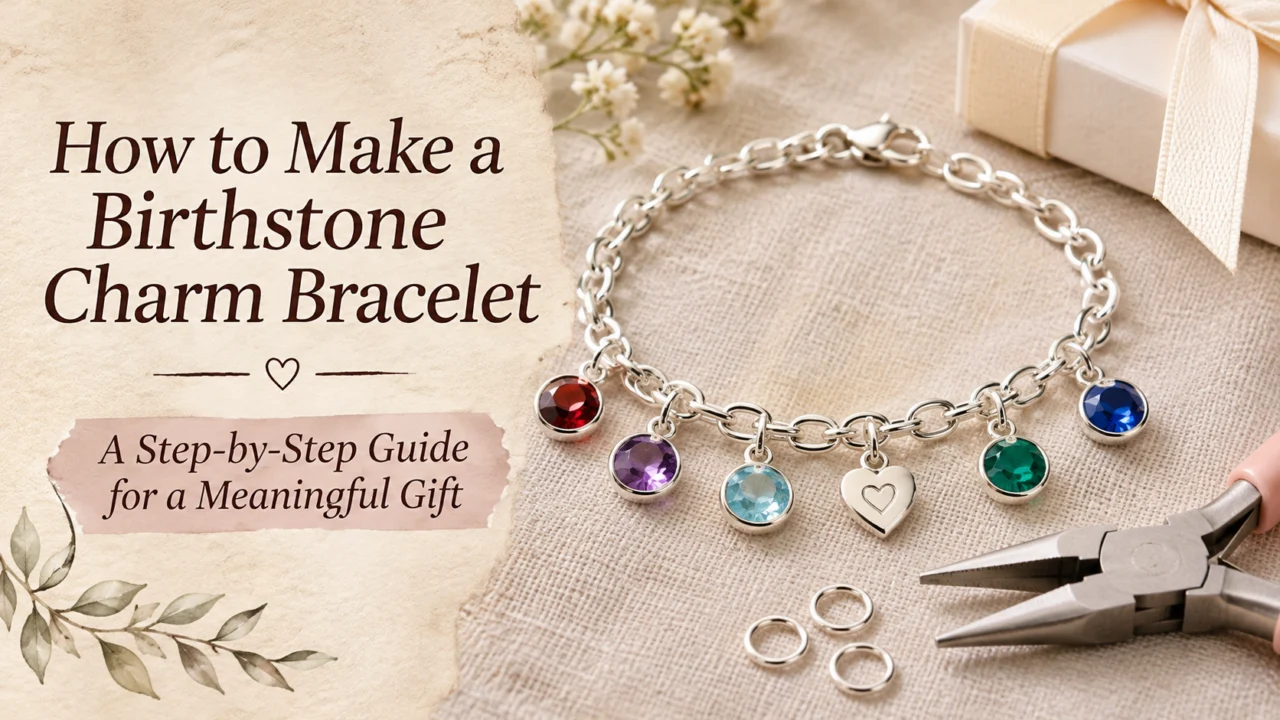
A birthstone charm bracelet is a thoughtful way to turn someone’s birthday, family connections, or meaningful memories into a piece of jewelry they can wear. Even better, you don’t need professional jewelry-making experience to create one.
Learning how to make a birthstone charm bracelet starts with a few simple decisions: choosing the right gemstones, finding a comfortable bracelet base, and attaching each charm securely. You can create a delicate bracelet with a single birthstone or combine several stones to represent loved ones.
This step-by-step guide covers everything from supplies and sizing to personalization ideas and finishing touches that make a handmade gift feel truly special.
What Is a Birthstone Charm Bracelet?
A birthstone charm bracelet is a bracelet decorated with gemstone charms representing particular birth months. Each stone adds color and personal meaning, making this style especially popular for birthdays, anniversaries, Mother’s Day, and other sentimental occasions.
For example, a bracelet with an amethyst charm can celebrate someone born in February. A bracelet featuring garnet, emerald, and sapphire might represent three family members born in January, May, and September.
Birthstone bracelets can be made with genuine gemstones, lab-created stones, or colored crystal and glass charms that resemble traditional birthstones.
The beauty of making your own is that you control the materials, arrangement, and personal details.
Supplies You’ll Need to Make a Birthstone Charm Bracelet
Before getting started, gather your jewelry-making materials.
For a beginner-friendly chain bracelet, you’ll need:
- Bracelet chain: Sterling silver, gold-filled, or another suitable jewelry-making metal.
- Birthstone charms: Ready-made gemstone charms with secure loops or settings.
- Jump rings: Small metal rings used to attach charms to the chain.
- Lobster clasp: A secure closure if your chain doesn’t already have one.
- Two pairs of jewelry pliers: Chain-nose or flat-nose pliers for opening and closing jump rings.
- Jewelry cutters: For shortening unfinished chain if necessary.
- Measuring tape: To check bracelet length.
- Optional personalized charms: Initials, hearts, engraved discs, or symbolic shapes.
The easiest option for beginners is a finished bracelet chain with an attached clasp. This eliminates the need to assemble the bracelet’s closure and lets you focus on arranging the birthstones.
Choose charms designed for hanging on jewelry. Loose gemstones without drilled holes or metal settings need additional components and techniques before they can be attached.
Step 1: Choose the Right Birthstones
The most important part of a personalized birthstone bracelet is selecting gemstones that represent the person receiving it.
Here is a helpful guide to commonly recognized birthstones in the United States.
| Birth Month | Birthstone Options | Typical Colors |
|---|---|---|
| January | Garnet | Deep red |
| February | Amethyst | Purple |
| March | Aquamarine, bloodstone | Pale blue, dark green |
| April | Diamond | Colorless and other colors |
| May | Emerald | Green |
| June | Pearl, alexandrite, moonstone | White, color-changing, varied |
| July | Ruby | Red |
| August | Peridot, spinel, sardonyx | Green, varied |
| September | Sapphire | Blue and other colors |
| October | Opal, tourmaline | Multicolored, varied |
| November | Topaz, citrine | Yellow, orange, varied |
| December | Turquoise, tanzanite, zircon | Blue, violet, varied |
Some months have multiple accepted birthstones, giving you flexibility when choosing colors and materials.
You don’t have to use expensive natural gemstones. Lab-created gemstones and birthstone-colored crystals can provide attractive alternatives.
Just make sure you understand what you’re buying. A purple glass charm may represent February’s birthstone color, but it shouldn’t be described as genuine amethyst.
Should You Use One Birthstone or Several?
For a birthday gift, a single birthstone charm creates a simple, personal design.
For a mother or grandmother, consider using the birthstones of her children or grandchildren.
For a partner, you might combine both of your birthstones with a small heart or engraved initial.
There is no required number of charms. The best arrangement is one that feels meaningful without making the bracelet uncomfortable or crowded.
Step 2: Select a Bracelet Style and Metal
The bracelet base affects the finished piece’s appearance, comfort, and durability.
Three styles work particularly well for birthstone charms.
Classic Chain Charm Bracelet
A link-chain bracelet is one of the easiest designs to customize. Individual birthstone charms can hang from separate chain links using jump rings.
It also allows you to add more charms later.
Delicate Cable Chain Bracelet
A fine cable chain creates a minimalist look, especially with one to three small gemstone charms.
Choose a chain strong enough to support the charms. Very thin links may not be suitable for heavier pendants.
Adjustable Charm Bracelet
An adjustable bracelet with an extension chain or sliding closure offers flexibility when the recipient’s exact wrist measurement is unknown.
Check that the closure is compatible with the bracelet materials and that the charms won’t interfere with the adjustment mechanism.
Which Metal Should You Choose?
Sterling silver is a popular choice for handmade jewelry because of its appearance and versatility. Genuine sterling silver contains 92.5% silver and may tarnish over time.
Gold-filled components offer a more substantial bonded gold layer than ordinary gold plating, although their durability still depends on construction and use.
Gold-plated components can be attractive and economical, but their surface finish may wear with friction.
If you’re mixing bracelet components, try to match both the metal color and material quality. A durable bracelet chain won’t prevent a thinly plated charm from wearing over time.
Step 3: Measure the Bracelet for a Comfortable Fit
A thoughtful gift should be comfortable enough to wear regularly.
Start by measuring the recipient’s wrist with a flexible measuring tape. If the measurement is unavailable, an adjustable bracelet is usually the more forgiving choice.
For a traditional chain charm bracelet, adding approximately 0.5 to 1 inch to the wrist circumference is a useful starting point, depending on the desired fit and charm size.
For example, a 6.5-inch wrist might be comfortable with a bracelet approximately 7 to 7.5 inches long.
This is only a general guide. Large or numerous charms may change how the bracelet sits, and some people prefer a snugger fit.
Measure the bracelet’s finished wearable length, including the clasp, rather than the chain alone.
Before adding charms, check that the bracelet can move comfortably around the wrist without slipping over the hand.
Step 4: Plan Your Birthstone Charm Arrangement
Lay the bracelet flat on a clean, soft surface.
Position the birthstone charms beside the chain before attaching anything. This makes it easier to experiment with different arrangements.
Here are three simple layout ideas:
- Centerpiece design: Place one birthstone charm in the center with smaller decorative charms on either side.
- Evenly spaced design: Distribute three to five birthstones across the front portion of the bracelet.
- Family birthstone design: Arrange gemstones according to family members’ birth months, ages, or another meaningful order.
If you’re creating a bracelet with several stones, think about their combined weight.
Heavy charms concentrated in one area may cause the bracelet to rotate on the wrist. Smaller charms spaced across the chain often feel more balanced.
Also check that nearby charms have enough space to move without constantly striking one another.
Step 5: Attach the Birthstone Charms Securely
This is the most important hands-on step in making your birthstone charm bracelet.
Using proper jump ring techniques helps prevent charms from slipping off during wear.
How to Attach a Charm With a Jump Ring
- Hold a jump ring with two pairs of jewelry pliers, positioning one pair on each side of the opening.
- Gently twist one side toward you and the other away from you. Do not pull the ring outward into an oval.
- Slide the open jump ring through the loop at the top of your birthstone charm.
- Pass the jump ring through the selected bracelet chain link.
- Twist the jump ring back into its original position.
- Check that both ends meet evenly with no visible gap.
Repeat for the remaining charms.
For valuable or frequently worn jewelry, appropriately sized soldered or welded closed connections may provide greater security than ordinary open jump rings. Have a qualified jeweler complete that work if needed.
Avoid using soft, thin craft jump rings for heavier gemstone charms.
Once all charms are attached, gently tug each connection to check for looseness. Avoid pulling hard enough to bend the findings.
Step 6: Add Personal Touches That Make the Bracelet Special
Birthstones already carry personal significance, but small details can make the finished bracelet even more memorable.
An initial charm is a simple addition that works particularly well beside a single gemstone.
For a mother’s bracelet, consider combining birthstones with a small engraved disc featuring the word “Mom” or a meaningful family date.
For a romantic gift, pair two birthstones representing each partner with a small heart charm.
You could also add a tiny star, flower, or other symbol connected to a shared memory.
Keep the overall design balanced. A few carefully selected details usually make a stronger visual impression than adding every available charm.
Step 7: Inspect, Clean, and Package Your Bracelet
Before presenting the bracelet, inspect the finished piece.
Look closely at each jump ring, clasp, and charm attachment. Confirm that no sharp edges catch on fabric and that the charms move freely.
Make sure the clasp opens and closes properly.
If the bracelet needs cleaning, use a soft, dry, lint-free cloth to remove fingerprints. Avoid soaking a finished birthstone bracelet without confirming that every gemstone, adhesive, finish, and metal component can tolerate water.
This is especially important when working with pearls, opals, turquoise, and other potentially delicate materials.
Place the finished bracelet in a soft jewelry pouch or a lined gift box.
For an especially personal presentation, include a handwritten note explaining what each gemstone represents.
Creative Birthstone Charm Bracelet Gift Ideas
The same basic bracelet-making technique can be adapted for different relationships and occasions.
A Mother’s Birthstone Bracelet
Choose a birthstone for each child and arrange the charms chronologically by birth date. Add an engraved heart or family initial in the center.
For a larger family, consider smaller gemstone charms to keep the bracelet comfortable.
A Best Friend Birthstone Bracelet
Combine your birthstone with your best friend’s birthstone.
A pair of complementary gemstone charms can create a subtle friendship design without requiring matching bracelets.
A Couples’ Birthstone Bracelet
Use two birthstones to represent your birthdays, paired with a small initial charm or meaningful symbol.
For a more understated design, place the stones close together in the center of a delicate chain.
A Milestone Birthday Bracelet
Choose the recipient’s birthstone and add charms representing important experiences, achievements, or favorite interests.
Leaving a little room for future charms also makes the bracelet an evolving keepsake.
Common Mistakes to Avoid When Making a Birthstone Bracelet
Small construction details make a noticeable difference in how the finished bracelet looks and wears.
Using jump rings that are too thin: Weak rings can spread apart under pressure, allowing charms to fall off. Match the ring’s material, diameter, and wire thickness to the charm’s weight.
Choosing incompatible charms: Not every charm fits every chain. Check the charm loop’s opening and the chain link dimensions before purchasing.
Adding too many heavy stones: Multiple large gemstone charms can make a bracelet bulky, uncomfortable, and more likely to catch on clothing.
Ignoring gemstone durability: Pearls, opals, and some other gemstones need more careful handling than harder stones such as sapphires.
Forgetting the clasp: Make sure the recipient can fasten the bracelet comfortably, particularly if they’re likely to put it on without assistance.
Mixing materials without checking quality: A sterling silver chain paired with low-quality plated findings may experience uneven wear.
Taking a few extra minutes to inspect the components is worthwhile, especially when the bracelet is intended as a lasting gift.
How to Care for a Handmade Birthstone Charm Bracelet
Proper care depends on the metals and gemstones used.
For most handmade birthstone bracelets, a few habits are helpful:
- Remove the bracelet before swimming, showering, or applying lotions and perfume.
- Store it separately from other jewelry to reduce scratches and tangling.
- Wipe away fingerprints and surface residue with a soft cloth after wearing.
- Inspect jump rings and clasps regularly for signs of wear.
- Avoid ultrasonic or steam cleaners unless every component is confirmed suitable for that cleaning method.
Sterling silver may need occasional polishing with an appropriate silver cloth. Gold-plated jewelry generally requires gentler handling to protect its finish.
Pearls and other delicate gemstones should not be exposed to harsh cleaning chemicals.
When in doubt, follow the gemstone and component suppliers’ care instructions or consult a professional jeweler.
Frequently Asked Questions
Can beginners make a birthstone charm bracelet?
Yes. A finished chain bracelet, ready-made birthstone charms, jump rings, and two pairs of jewelry pliers are enough for a simple design. Beginners should practice opening and closing a few jump rings before assembling the final bracelet.
Can I use birthstone-colored beads instead of gemstones?
Absolutely. Glass, crystal, and other colored beads can represent birth months at a lower cost. Choose beads with suitable holes and secure them using properly formed wrapped loops or compatible jewelry findings.
How many birthstone charms should I add?
One to five small charms can work well for many bracelet designs, but there is no fixed limit. The ideal number depends on bracelet length, charm weight, and the desired appearance.
Can I add more birthstones later?
Yes, if the bracelet has suitable chain links and enough available space. Adding future birthstones can make the bracelet especially meaningful as a family grows or new milestones are celebrated.
Are birthstone charm bracelets good birthday gifts?
Yes. A bracelet featuring someone’s birth month is a personal choice, and adding initials or meaningful symbols can make the gift even more special. Choosing the right size and jewelry material is just as important as the birthstone itself.
A Small Handmade Gift With Lasting Meaning
Making a birthstone charm bracelet isn’t about mastering complicated jewelry techniques. It’s about choosing a few meaningful elements and assembling them with care.
Start with a comfortable bracelet base, select birthstones that tell a personal story, and use secure connections that suit the weight of each charm. Add just enough personalization to reflect the recipient’s style and the occasion.
The finished bracelet becomes more than an accessory. It’s a wearable reminder of someone, something, or some moment worth remembering.