
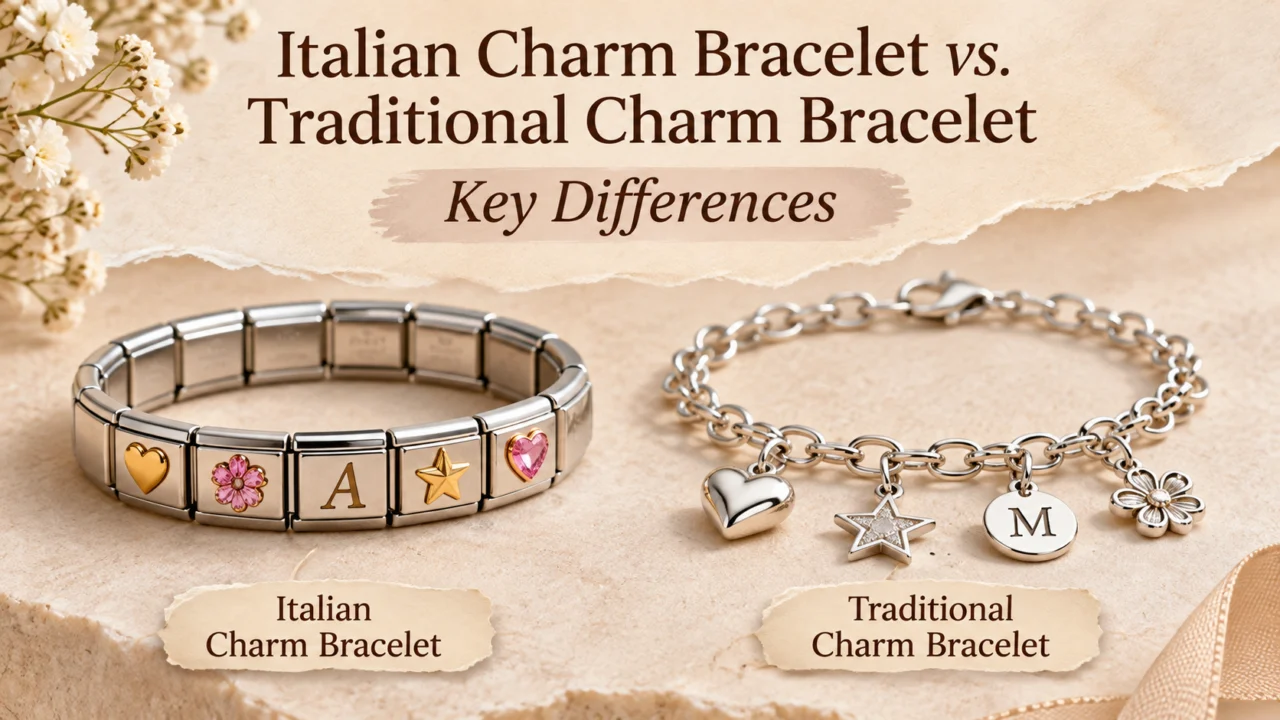
Charm bracelets are a timeless way to express personal style, celebrate meaningful moments, and collect memories. But when choosing between an Italian charm bracelet and a traditional charm bracelet, the differences go beyond appearance.
Italian charm bracelets feature flat, interchangeable links that form a flexible band, while traditional charm bracelets typically have decorative charms hanging from a chain. Both styles offer personalization, but they differ in comfort, construction, sizing, and how charms are added.
This guide explains the key differences between Italian and traditional charm bracelets, including their materials, customization options, everyday practicality, and what to consider before buying.
What Is an Italian Charm Bracelet?
An Italian charm bracelet is a modular bracelet made from individual metal links that connect to create a flexible band around the wrist.
Instead of hanging from a chain, the decorative charms are integrated directly into the bracelet’s structure. Each link can feature a letter, symbol, image, gemstone accent, or personalized design.
Many Italian charm bracelets use approximately 9mm-wide links, although sizes and connection systems can vary between manufacturers.
A typical Italian charm bracelet includes:
- Interchangeable links: Individual sections can be removed, replaced, or rearranged.
- Flat decorative surfaces: Designs sit close to the wrist rather than hanging below it.
- Spring-loaded connections: Many styles use small mechanisms that allow links to connect.
- Adjustable sizing: Adding or removing links changes the bracelet’s circumference.
- Personalized designs: Initials, birthstones, hearts, animals, and travel symbols are popular choices.
Italian charm bracelets have a distinctive, streamlined appearance. Their modular construction allows the wearer to change the bracelet’s design without replacing the entire piece.
What Is a Traditional Charm Bracelet?
A traditional charm bracelet typically consists of a metal chain or bracelet base decorated with individual hanging charms.
These charms may represent special memories, important relationships, personal interests, or meaningful occasions.
Unlike Italian charm bracelets, the decorative elements are attached to the bracelet rather than forming its structure.
Traditional charm bracelets commonly feature:
- Chain or bangle bases: Often made from sterling silver, gold, or other jewelry metals.
- Dangling charms: Small decorative pendants that move with the wrist.
- Jump rings or clasps: Hardware used to attach individual charms.
- Multiple charm shapes: Hearts, lockets, initials, miniature objects, and symbolic designs.
- Expandable collections: Additional charms can be added as space and weight allow.
Some traditional bracelet systems use removable clips or specialized charm holders, while others require a jeweler to attach charms securely.
The defining feature is the bracelet’s decorative movement and layered appearance.
Italian vs. Traditional Charm Bracelet: Quick Comparison
| Feature | Italian Charm Bracelet | Traditional Charm Bracelet |
|---|---|---|
| Bracelet design | Flat, connected metal links | Chain or bangle with charms |
| Charm style | Integrated into bracelet links | Usually hangs from bracelet |
| Appearance | Sleek and structured | Decorative and dimensional |
| Customization | Replace or rearrange links | Add, remove, or reposition charms |
| Sizing | Adjusted by changing links | Determined by chain or bangle size |
| Movement | Generally stays close to wrist | Charms move and swing |
| Common materials | Stainless steel, decorative metal accents | Sterling silver, gold, and other metals |
| Daily comfort | Low-profile design | Depends on charm size and weight |
| Compatibility | Requires matching link system | Requires compatible attachment hardware |
Neither style is automatically better. The right choice depends on your preferred appearance, how frequently you want to customize your bracelet, and your everyday activities.
Key Differences Between Italian and Traditional Charm Bracelets
1. Design and Appearance
The most noticeable difference is the overall shape.
Italian charm bracelets resemble flexible metal bands composed of small rectangular sections. Their designs create a continuous pattern across the wrist.
Traditional charm bracelets have a more three-dimensional appearance. Their charms hang below the bracelet, creating movement and texture.
An Italian bracelet may appeal to someone who prefers minimalist jewelry or a clean, organized collection of symbols.
A traditional bracelet is often a better fit for someone who enjoys statement jewelry, miniature pendants, and a layered, nostalgic look.
However, neither category is limited to one aesthetic. Italian bracelets can be colorful and elaborate, while traditional bracelets can look understated with only one or two charms.
2. How Charms Are Added and Removed
Italian charm bracelets use a link-based system.
To personalize one, you generally remove a plain link and replace it with a decorative link. Many designs use spring-loaded connections that can be opened by hand or with a compatible link tool.
Traditional charm bracelets work differently.
Depending on the design, charms may attach using:
- Jump rings: Small metal rings connecting charms to the bracelet.
- Lobster clasps: Removable clasps that allow charms to be changed.
- Specialized holders: Attachment systems designed for particular bracelet collections.
Some traditional charms are permanently or semi-permanently attached, making professional assistance useful when removing them.
Italian bracelets are particularly convenient for rearranging an entire design, provided the links are compatible and the mechanism is in good condition.
Traditional charm bracelets may offer more variety in pendant shapes, but changing certain attachments takes additional effort.
3. Comfort and Everyday Wear
Comfort is another important difference when comparing Italian vs. traditional charm bracelets.
Italian charm bracelets generally sit closer to the wrist because their decorative links are relatively flat.
This low-profile design can make them convenient for everyday outfits, particularly when worn with long sleeves.
Traditional charm bracelets may require more attention during activities because dangling charms can catch on clothing, knock against surfaces, or become tangled.
However, Italian bracelets are not completely free from comfort concerns. A poorly sized band may pinch, and raised decorative elements can still snag delicate fabrics.
For either style, remove the bracelet during activities that could pull, bend, or damage the jewelry.
4. Bracelet Sizing and Fit
Italian charm bracelets are resized by adding or removing individual links.
If the bracelet feels tight, compatible links can be added. If it feels loose, one or more links can be removed.
The exact number required depends on link dimensions, wrist circumference, and the preferred fit.
Traditional charm bracelets are usually sized according to their chain length or bangle circumference.
Some chain bracelets include adjustable clasps or extender sections. Others may require professional resizing.
For a comfortable fit, measure your wrist and follow the manufacturer’s sizing guidance. The bracelet should move slightly without slipping over your hand or creating uncomfortable pressure.
Remember that heavy dangling charms can affect how a traditional bracelet hangs, even when the chain itself fits correctly.
5. Materials and Durability
Both styles are available in different materials, and quality depends more on construction than on the bracelet category.
Italian charm bracelets frequently feature stainless steel bases, sometimes decorated with enamel, colored finishes, or metal accents.
Stainless steel is generally resistant to everyday corrosion, but decorative coatings and attached embellishments may still scratch or deteriorate.
Traditional charm bracelets commonly use sterling silver, solid gold, gold-filled components, or plated metals.
Sterling silver can tarnish over time, while gold-plated finishes may gradually wear with friction.
Gold-filled jewelry typically has a thicker mechanically bonded gold layer than conventional gold plating, although durability still depends on construction and use.
When comparing bracelets, examine the material of both the base and the charms. A durable bracelet chain does not automatically mean every charm attachment will be equally durable.
Which Charm Bracelet Is Easier to Personalize?
Both bracelet styles support meaningful customization, but the experience is different.
Personalizing an Italian Charm Bracelet
Italian charm bracelets work especially well for coordinated designs.
For example, you could create a bracelet featuring:
- Your initials or name
- A favorite flower or animal
- A meaningful date
- A birthstone-inspired design
- Symbols representing travel destinations
- Matching charms for family members
Because every decorative link becomes part of the band, you can arrange the designs in a deliberate sequence.
You can also replace outdated or damaged links without redesigning the entire bracelet, assuming compatible replacements are available.
Personalizing a Traditional Charm Bracelet
Traditional charm bracelets are ideal for collecting individual pieces over time.
Someone might begin with a heart charm and later add a graduation cap, travel souvenir, initial pendant, or anniversary symbol.
The charms do not necessarily need to share the same shape or size, provided their weight and attachment systems suit the bracelet.
This flexibility makes traditional charm bracelets particularly appealing for milestone collections.
Can You Mix Italian and Traditional Bracelet Charms?
Generally, Italian and traditional charm bracelet components are not directly interchangeable.
Italian charms are designed to connect through a specific modular link mechanism. Traditional dangling charms usually require a chain, jump ring, or clasp.
However, some Italian charm systems offer special links with small dangling pendants attached.
These provide the appearance of a traditional charm while retaining the modular bracelet structure.
Before purchasing additional charms, confirm the following:
- Link dimensions and connection mechanisms
- Manufacturer or collection compatibility
- Bracelet material and finish
- Whether the attachment is designed for your bracelet
Even when two links are advertised as 9mm, that measurement alone does not guarantee compatibility.
Which Bracelet Makes a Better Gift?
Both styles can make thoughtful gifts, particularly when their designs reflect the recipient’s interests.
An Italian charm bracelet may be a good choice for someone who enjoys compact jewelry, coordinated designs, and frequently changing accessories.
It can also be appealing for someone who prefers not to wear dangling jewelry.
A traditional charm bracelet may suit someone who enjoys collecting keepsakes, wearing expressive accessories, or receiving individual charms to celebrate meaningful events.
Before giving either style, consider wrist size, preferred metal color, and existing jewelry collections.
If the recipient already owns a charm bracelet, choosing compatible additions can be more useful than introducing an entirely different system.
How to Care for Both Bracelet Styles
Proper care helps maintain the appearance and function of personalized jewelry.
For Italian charm bracelets, gently wipe the surfaces with a soft cloth after wearing. Pay attention to dirt trapped between links, and avoid forcing spring-loaded mechanisms.
For traditional charm bracelets, inspect jump rings and clasps periodically to make sure the attachments remain secure.
Additional care considerations include:
- Store jewelry separately to minimize scratches and tangling.
- Remove bracelets before swimming, exercising, or using household cleaning products.
- Keep perfume, lotions, and harsh chemicals away from delicate finishes.
- Use cleaning methods appropriate for the metal, gemstones, and decorative details.
- Avoid prolonged moisture exposure, particularly when charms contain glued stones or sensitive materials.
Sterling silver, stainless steel, plated finishes, pearls, and porous gemstones have different cleaning requirements. Do not assume a cleaner suitable for one material is safe for every charm.
Common Mistakes to Avoid When Buying a Charm Bracelet
A little planning can prevent disappointing purchases.
Buying incompatible charms: Not all Italian link systems or traditional attachment styles work together.
Ignoring bracelet weight: Too many heavy dangling charms can make a traditional bracelet uncomfortable or place extra strain on its hardware.
Choosing the wrong size: Italian bracelets can pinch when too tight, while oversized traditional bracelets may slide excessively.
Overlooking metal finishes: A bracelet described as gold-colored is not necessarily made of solid gold or gold-filled material.
Forgetting replacement availability: Before committing to a particular modular system, consider whether compatible links will be easy to find later.
Checking these details is especially important when purchasing personalized jewelry that you hope to expand over several years.
Frequently Asked Questions
Are Italian charm bracelets better than traditional charm bracelets?
Neither style is universally better. Italian charm bracelets offer a streamlined, modular design, while traditional charm bracelets provide more movement and variety in hanging pendants. Your choice depends on comfort, appearance, and customization preferences.
Do Italian charm bracelets stretch?
Many Italian charm bracelets use spring-loaded links that expand slightly as the bracelet moves or is adjusted. They are not stretchy like elastic bracelets, and their mechanisms should not be pulled beyond their intended range.
Can you add regular charms to an Italian charm bracelet?
Regular dangling charms generally cannot attach directly to standard Italian links. You may need a compatible adapter or a specially designed dangle link.
Are traditional charm bracelets still fashionable?
Traditional charm bracelets remain a versatile jewelry style. Their appeal comes from personal storytelling, collectible designs, and the ability to combine sentimental pieces with contemporary accessories.
Can you wear Italian and traditional charm bracelets together?
Yes. Wearing both styles can create an interesting contrast between a structured metal band and a bracelet with moving charms. Choose complementary materials and avoid stacking pieces that may scratch or catch on one another.
Final Thoughts: Which Charm Bracelet Should You Choose?
The main difference between an Italian charm bracelet and a traditional charm bracelet is how the charms become part of the jewelry.
Italian charm bracelets use interchangeable links to create a sleek, personalized band. Traditional charm bracelets feature separate decorative charms that often hang from a chain.
Choose an Italian bracelet if you prefer a low-profile design, link-by-link customization, and relatively simple resizing. Consider a traditional charm bracelet if you enjoy dangling pendants, varied charm shapes, and collecting keepsakes over time.
Most importantly, choose a bracelet with compatible components, durable construction, and a comfortable fit. Both styles can become meaningful collections that reflect your personal story.