
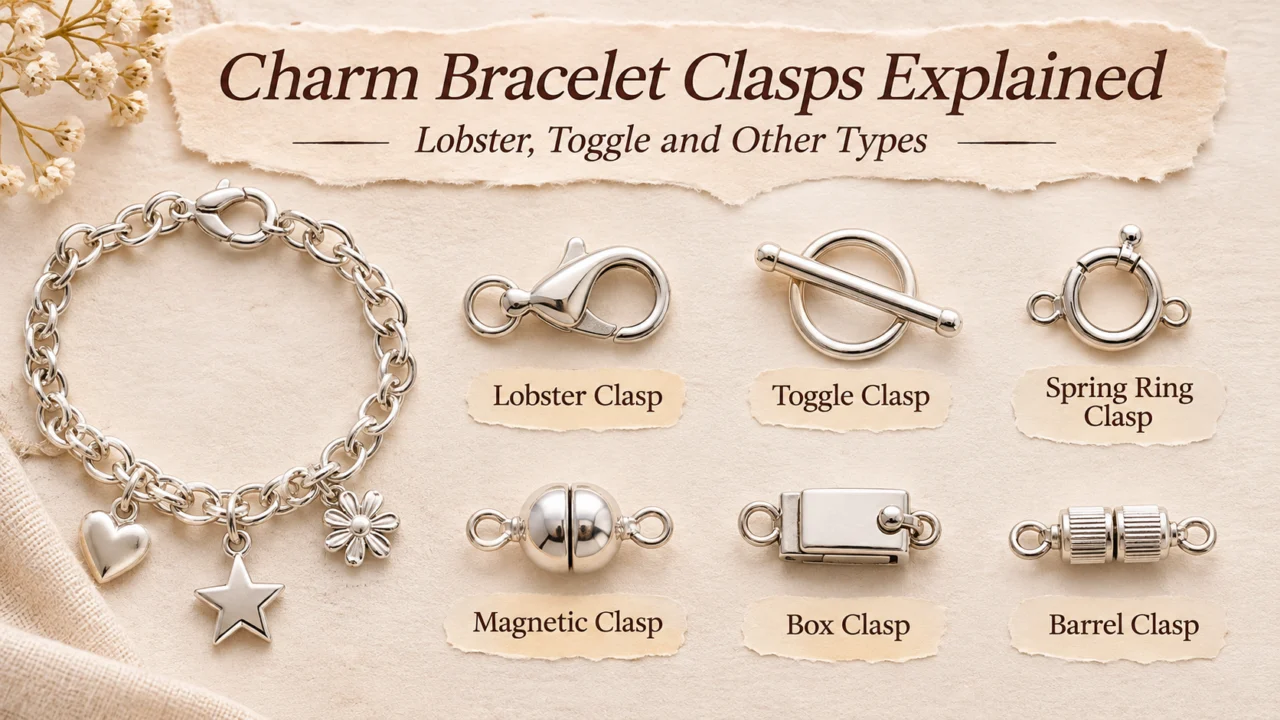
A charm bracelet’s clasp might seem like a small detail, but it plays an important role in keeping your jewelry secure, comfortable, and easy to wear. The right closure can make a bracelet effortless to put on, while the wrong one can be frustrating to fasten or more likely to open accidentally.
Understanding the different charm bracelet clasp types can help you choose a bracelet that suits your lifestyle, wrist size, and collection of charms. From reliable lobster clasps to decorative toggle closures, each design has its own advantages and limitations.
Here’s how the most common bracelet clasps work, which styles are best for everyday wear, and what to check before buying.
Why the Clasp Matters on a Charm Bracelet
Charm bracelets are different from many ordinary chain bracelets because their weight and balance can change as you add charms.
A bracelet holding several dangling charms may place more stress on its closure than a lightweight chain bracelet. Larger charms can also catch on clothing or create movement that makes a poorly fitted bracelet more vulnerable to slipping off.
A suitable clasp should provide three essential benefits:
- Security: It should stay closed during normal movement.
- Convenience: You should be able to fasten and release it without excessive difficulty.
- Compatibility: It should work with the bracelet’s chain, connectors, and overall weight.
Appearance matters, too. Some clasps are intentionally decorative, while others are designed to blend into the bracelet.
1. Lobster Clasp: A Popular Choice for Everyday Wear
The lobster clasp is one of the most common closures used on charm bracelets.
It gets its name from its curved, claw-like shape. A small spring-loaded lever opens the clasp, allowing it to connect to a jump ring or chain link. Releasing the lever closes the opening.
Advantages of Lobster Clasps
Lobster clasps offer several practical benefits:
- A spring-loaded mechanism that helps keep the closure shut
- A relatively compact design
- Compatibility with many chain bracelet styles
- Availability in sterling silver, gold, and other jewelry materials
- Easy replacement by a jeweler when necessary
They’re particularly useful for charm bracelets with multiple dangling charms because a properly sized, well-made lobster clasp can provide dependable closure.
Potential Drawbacks
Small lobster clasps can be difficult to operate with one hand, especially for people with limited finger dexterity or long fingernails.
The internal spring can also weaken or become damaged over time.
Best for: Everyday charm bracelets, sterling silver chains, adjustable bracelets, and designs carrying several charms.
2. Toggle Clasp: Decorative and Easy to Fasten
Toggle clasps have a distinctive design featuring a circular or shaped loop and a straight bar.
To close the bracelet, you pass the bar through the loop and turn it sideways. The bar rests across the opening, helping prevent the bracelet from coming apart.
Unlike lobster clasps, traditional toggle closures don’t rely on a spring.
Advantages of Toggle Clasps
Toggle clasps are popular because they’re:
- Relatively easy to operate with one hand
- Attractive enough to serve as a decorative feature
- Available in simple and elaborate designs
- Suitable for many vintage-inspired and statement bracelets
A polished silver toggle clasp can complement a bracelet filled with meaningful charms without looking like an ordinary fastening mechanism.
Are Toggle Clasps Secure?
Toggle clasps depend heavily on fit, bar length, loop size, and bracelet tension.
If the bracelet is too loose, the bar may accidentally align with the opening and slip through. A heavy charm arrangement can also affect how the bracelet hangs.
For better security, choose a toggle with a bar that extends comfortably beyond both sides of the loop and make sure the bracelet fits correctly.
Best for: Decorative charm bracelets, vintage-inspired designs, and people who prefer an easy-to-handle closure.
3. Spring Ring Clasp: Small and Traditional
Spring ring clasps are circular closures with a small retractable opening.
Pulling back a tiny lever opens the ring. Releasing it allows an internal spring to return the opening to its closed position.
You’ll often find this style on delicate chains and traditional jewelry.
Advantages and Limitations
Spring ring clasps are discreet, lightweight, and suitable for fine bracelet designs.
However, they’re often smaller and more difficult to manipulate than lobster clasps.
A very small spring ring may also be less practical for a bracelet carrying numerous heavy charms.
Best for: Lightweight charm bracelets, delicate chains, and minimalist jewelry.
4. Magnetic Clasp: Convenient but Requires Caution
Magnetic clasps use magnets inside two connecting components to hold a bracelet together.
They can be particularly convenient for anyone who struggles with traditional jewelry fasteners.
Instead of handling a tiny lever, you bring the clasp ends together until the magnets connect.
Benefits of Magnetic Clasps
Their main advantages include:
- Simple one-handed fastening
- No small spring lever to operate
- A clean appearance
- Convenience for people with limited hand dexterity
Important Security Considerations
Not all magnetic clasps provide the same holding strength.
A bracelet with heavy or numerous charms may separate if its magnetic closure is pulled, caught on clothing, or subjected to sudden movement.
Some designs include secondary mechanical locks that improve security.
People with pacemakers or other implanted medical devices should also follow the device manufacturer’s guidance regarding magnets and separation distances.
Best for: Lightweight bracelets and wearers who prioritize easy fastening, provided the clasp is appropriate for the bracelet’s weight.
5. Box Clasp: A Secure-Looking, Structured Closure
Box clasps feature a small tab that slides into a decorative housing and locks into place.
Some versions also include a figure-eight safety latch or another secondary fastening mechanism.
Box clasps are frequently used on more structured jewelry designs, including certain gemstone bracelets and decorative link bracelets.
Why Choose a Box Clasp?
A well-made box clasp can offer a neat appearance and a satisfying locking mechanism.
Decorative box clasps may incorporate engraved patterns, gemstones, or polished metal designs.
However, the locking tongue can wear or bend. If the clasp no longer clicks securely into position, it should be inspected rather than forced closed.
Best for: Structured charm bracelets, decorative metal bracelets, and designs where the clasp contributes to the overall appearance.
6. Barrel Clasp: A Traditional Screw Closure
A barrel clasp generally consists of two cylindrical components that screw together.
The design creates a smooth, streamlined closure.
Barrel clasps appear on some traditional chain and beaded bracelets, although they’re less convenient for charm bracelets worn frequently.
Their biggest limitation is that fastening the two components often requires both hands.
The threaded sections can also loosen if they aren’t tightened properly.
Best for: Certain traditional or lightweight bracelet designs where a streamlined appearance is preferred.
Charm Bracelet Clasp Types Compared
The following comparison can help narrow down your options.
| Clasp Type | Ease of Fastening | Security Considerations | Best Use |
|---|---|---|---|
| Lobster | Moderate | Spring and connecting ring must be sound | Everyday charm bracelets |
| Toggle | Easy | Fit and bar-to-loop proportions are critical | Decorative bracelets |
| Spring ring | Moderate to difficult | Small spring and ring require inspection | Delicate charm bracelets |
| Magnetic | Very easy | Can separate under pulling force | Lightweight bracelets |
| Box | Moderate | Locking tab should engage fully | Structured jewelry |
| Barrel | Difficult with one hand | Threaded connection must stay tight | Traditional bracelet styles |
No clasp is automatically secure in every situation. Construction quality, bracelet fit, wear, and maintenance all affect performance.
Which Charm Bracelet Clasp Is the Most Secure?
For many traditional chain charm bracelets, a well-made lobster clasp is a practical choice for everyday security.
Its spring-operated closure makes accidental opening less likely during ordinary wear, provided the clasp and connecting rings are in good condition.
However, security also depends on how the rest of the bracelet is constructed.
A strong clasp won’t help much if the connecting jump ring is thin, improperly closed, or damaged.
A quality box clasp with a functioning secondary safety latch can also be an excellent option for compatible bracelet designs.
For particularly valuable or sentimental charm bracelets, consider adding a safety chain where the design allows it.
A safety chain creates an additional connection between the bracelet’s ends, potentially preventing complete loss if the primary clasp comes undone.
How to Choose the Right Clasp for Your Charm Bracelet
The best closure depends on more than appearance.
Consider the Number and Weight of Your Charms
A bracelet with one or two small charms generally places less demand on the closure than one filled with substantial metal charms.
For heavier bracelets, prioritize sturdy clasp construction and secure connectors.
The clasp should be appropriately sized for the chain and the total weight of the finished bracelet.
Think About How Often You’ll Wear It
If you plan to wear your charm bracelet regularly, choose a closure that you can manage comfortably.
Lobster clasps are versatile for everyday use, while toggle clasps may be easier for someone who has difficulty handling small mechanisms.
For occasional statement jewelry, a decorative box or toggle clasp might be especially appealing.
Check the Bracelet’s Fit
A clasp works best when the bracelet fits properly.
An overly tight bracelet can put extra stress on its connections. An excessively loose bracelet may catch on objects or, with certain toggle designs, be more susceptible to accidental opening.
A comfortable fit generally allows a little movement without letting the bracelet slide easily over your hand.
Measure your wrist and follow the sizing guidance for the specific bracelet design, accounting for how the charms affect its fit.
Match the Clasp to the Jewelry Material
Consider the metal and finish of your bracelet before choosing a replacement clasp.
Common options include:
- Sterling silver: A suitable choice for sterling silver bracelets, although it may tarnish over time.
- Solid gold: Often selected for fine jewelry because of its durability and material value, depending on the alloy.
- Gold-filled: Provides a relatively thick mechanically bonded gold layer over a base metal, but clasp construction and gold coverage can vary.
- Gold-plated: Offers a gold-colored finish, although plating may wear with friction and repeated use.
- Stainless steel: A durable option for compatible bracelet designs, with corrosion resistance depending on the steel grade and environment.
Matching the visible finish can improve appearance, but matching the clasp’s size, construction, and attachment method is equally important.
Can You Replace a Charm Bracelet Clasp?
Yes. Many traditional chain charm bracelets allow clasp replacement.
A jeweler can often remove a worn clasp and install a new one using suitable connecting rings or other attachment methods.
This may also provide an opportunity to switch from a difficult spring ring to a larger lobster clasp.
However, not every bracelet is designed for a simple clasp change.
Italian charm bracelets, for example, commonly use expandable modular links rather than traditional chain clasps. Other specialty bracelets may have integrated closures that require manufacturer-specific parts.
Before replacing a clasp, check that the new mechanism is compatible with the bracelet’s construction, metal, and weight.
For valuable jewelry, professional replacement is usually preferable to attempting repairs with household tools.
How to Keep Your Bracelet Clasp in Good Condition
Even a reliable clasp needs occasional attention.
A few simple habits can help prevent problems:
- Inspect the closure regularly. Check for looseness, bent components, gaps, or unusual movement.
- Keep the mechanism clean. Remove surface dirt using a soft cloth and cleaning methods appropriate for the jewelry material.
- Avoid forcing stuck clasps. Pulling or twisting can damage small springs and connecting rings.
- Remove your bracelet during rough activities. Sports, heavy lifting, and activities involving snagging hazards can stress the closure.
- Store bracelets carefully. Keeping them separated helps prevent chains and charms from tangling around clasps.
If a lobster or spring ring clasp no longer closes completely, have it repaired or replaced.
Similarly, stop wearing a toggle clasp if its bar becomes bent or its loop appears distorted.
Don’t rely on a questionable clasp simply because it still closes occasionally.
Common Questions About Charm Bracelet Clasps
Is a lobster clasp better than a toggle clasp?
A lobster clasp is generally a more practical choice for everyday security on a traditional chain charm bracelet. Toggle clasps are often easier to fasten and more decorative, but their security depends heavily on fit and design.
What is the easiest bracelet clasp to use with one hand?
Magnetic clasps are often the easiest to connect with one hand. Toggle clasps can also be convenient, particularly when the bar and loop are large enough to handle comfortably.
Can a heavy charm bracelet use a magnetic clasp?
It depends on the clasp’s rated holding strength, construction, and bracelet design. For a heavy bracelet carrying valuable charms, a suitable mechanical clasp is generally the more cautious choice.
Why does my charm bracelet clasp keep opening?
Possible causes include a weakened spring, bent components, an improperly closed connecting ring, or an unsuitable closure for the bracelet’s weight. A jeweler can help identify the problem.
Can I add a safety chain to a charm bracelet?
Many traditional chain charm bracelets can accommodate a safety chain. However, attachment points and bracelet construction determine whether one can be installed securely.
Choosing a Clasp That Keeps Your Charms Secure
A charm bracelet’s closure deserves as much attention as the charms themselves.
For everyday chain bracelets, lobster clasps offer a useful combination of security, compact design, and versatility. Toggle clasps are attractive and convenient, while magnetic, box, spring ring, and barrel closures serve different needs.
The best choice is a clasp that suits your bracelet’s weight, fits your wrist comfortably, and closes reliably every time.
Before adding more sentimental charms to your collection, take a moment to inspect the closure and connecting rings. Those small components play a big role in protecting the memories your bracelet holds.