
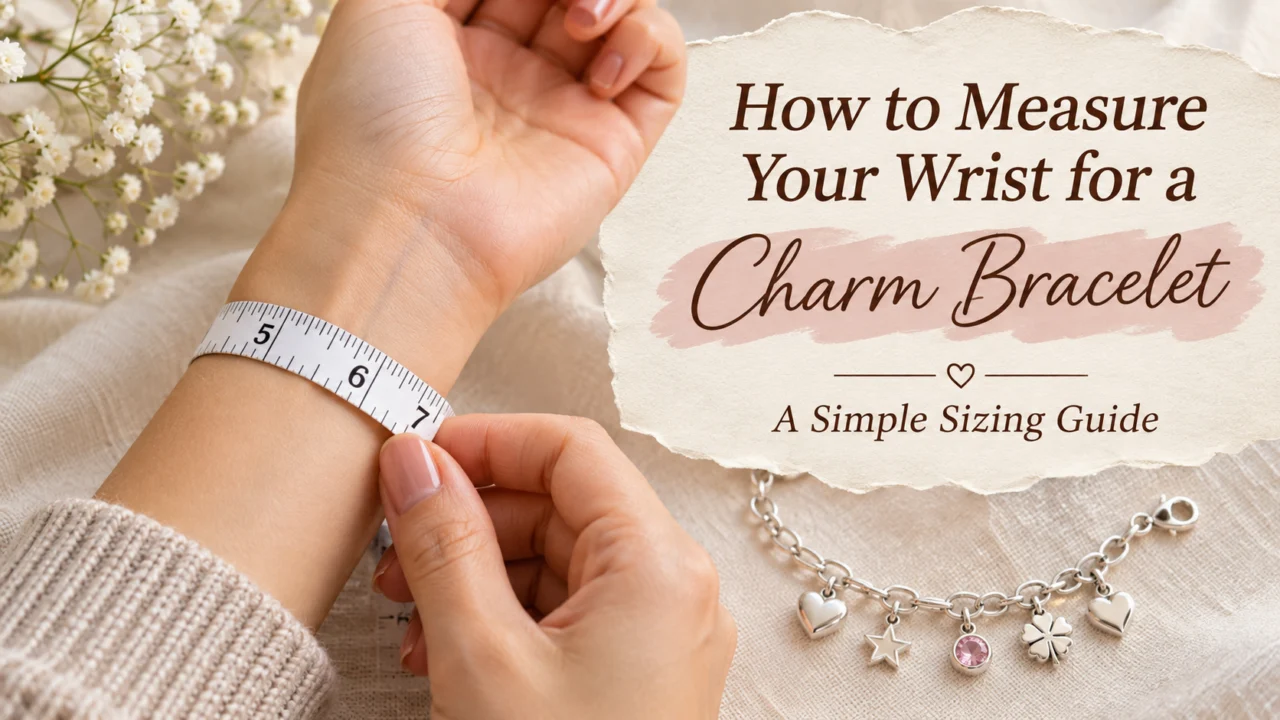
Finding the right charm bracelet starts with one simple measurement: your wrist size. A bracelet that’s too tight can feel uncomfortable, especially after adding charms, while one that’s too loose may slide excessively or slip off your hand.
Learning how to measure your wrist for a charm bracelet takes just a few minutes and can help you avoid common sizing mistakes. All you need is a flexible measuring tape or a piece of string and a ruler.
This guide explains how to measure accurately, how much extra room to allow for comfort, and how to choose the right fit for different charm bracelet styles.
What You’ll Need to Measure Your Wrist
You don’t need any special jewelry tools to measure your wrist at home.
Gather these simple items:
- Flexible measuring tape: A soft sewing tape is ideal for measuring around your wrist.
- String or ribbon: A useful alternative if you don’t have measuring tape.
- Ruler: Needed to measure the length of your string or ribbon.
- Pen: Helpful for marking where the string overlaps.
For the most accurate result, measure your bare wrist rather than measuring over clothing or another bracelet.
How to Measure Your Wrist for a Charm Bracelet: Step by Step
The process is straightforward, but measuring the correct part of your wrist makes a difference.
Step 1: Find the Right Measuring Spot
Place your hand in a relaxed position with your palm facing upward.
Locate the wrist bone near the base of your hand. Wrap the measuring tape around the area where you normally wear a bracelet, typically near the wrist bone on the forearm side.
Avoid measuring farther up your arm unless that’s where you prefer your bracelet to sit.
Step 2: Wrap the Measuring Tape Around Your Wrist
Wrap a flexible measuring tape around your wrist, keeping it flat against your skin.
The tape should fit snugly without squeezing or leaving an indentation.
You are measuring your actual wrist circumference, not your finished bracelet size.
For example, if the tape reads 6.25 inches, your wrist circumference is 6.25 inches.
Step 3: Measure With String if You Don’t Have a Tape
If you’re using string or ribbon, wrap it around your wrist in the same position.
Mark the point where the ends meet, then straighten the string against a ruler.
Read the measurement in inches or centimeters.
Use a nonstretchy string for better accuracy. Elastic materials can stretch while measuring and give an incorrect result.
Step 4: Double-Check Your Measurement
Repeat the measurement once or twice to make sure it’s consistent.
If you get slightly different measurements, check that you’re measuring the same location and using the same amount of tension.
Write down your wrist circumference before choosing a bracelet.
How Much Extra Room Should a Charm Bracelet Have?
Your wrist measurement is only the starting point. Most traditional charm bracelets need additional length to allow comfortable movement.
The amount of extra room depends on how you like your jewelry to fit.
| Fit preference | Add to wrist measurement | How it feels |
|---|---|---|
| Snug fit | 0.25–0.5 inch | Close to the wrist with limited movement |
| Comfortable fit | 0.5–0.75 inch | Allows some movement without feeling excessively loose |
| Loose fit | 0.75–1 inch | Drapes more freely and moves farther along the wrist |
These are general starting guidelines for traditional chain bracelets, not universal sizing rules.
Charm size, bracelet thickness, clasp construction, and manufacturer recommendations can all affect the final fit.
For most everyday chain charm bracelets, adding approximately 0.5–0.75 inch to your wrist measurement is a reasonable place to start.
However, bracelets with large beads or bulky charms may need additional room.
Charm Bracelet Size Chart
The following chart provides approximate starting sizes based on actual wrist circumference.
| Wrist circumference | Suggested bracelet length |
|---|---|
| 5.5 inches | 6–6.25 inches |
| 5.75 inches | 6.25–6.5 inches |
| 6 inches | 6.5–6.75 inches |
| 6.25 inches | 6.75–7 inches |
| 6.5 inches | 7–7.25 inches |
| 6.75 inches | 7.25–7.5 inches |
| 7 inches | 7.5–7.75 inches |
| 7.25 inches | 7.75–8 inches |
| 7.5 inches | 8–8.25 inches |
The chart uses a comfortable allowance of approximately 0.5–0.75 inch.
For example, someone with a 6.5-inch wrist might begin by trying a 7-inch or 7.25-inch charm bracelet.
Keep in mind that the stated bracelet length may not equal its usable inside circumference. Thick links, charms, and certain clasp designs can affect how much room the bracelet provides.
Always compare your measurement with the jewelry seller’s specific sizing instructions.
How to Measure for Different Types of Charm Bracelets
Not every charm bracelet fits the same way. Understanding the bracelet’s construction can help you choose a more accurate size.
Traditional Chain Charm Bracelets
Traditional charm bracelets usually feature a chain with dangling charms attached to individual links.
These bracelets generally need enough room to move comfortably around your wrist.
For a standard chain design, adding approximately 0.5–0.75 inch is often a useful starting point.
If you plan to attach several heavy charms, consider their combined weight. A heavily decorated bracelet may hang differently than an empty chain.
Also check whether the bracelet has an adjustable clasp or extension chain.
Snake Chain and Beaded Charm Bracelets
Snake chain bracelets, including many bead-style charm bracelets, can feel tighter as additional charms are added.
Large beads occupy space along the bracelet and reduce its usable interior circumference.
Some designs also become less flexible when they’re filled with charms.
For this reason, follow the manufacturer’s sizing guidelines rather than relying entirely on a standard chain bracelet chart.
If you’re building a bracelet gradually, think about how many charms you eventually want to wear.
Italian Charm Bracelets
Italian charm bracelets use flat, interlocking links that form a flexible band around the wrist.
Their sizing works differently from traditional chain charm bracelets.
Instead of selecting a fixed chain length, you typically adjust the bracelet by adding or removing compatible links.
To measure for an Italian charm bracelet:
- Measure your wrist circumference.
- Check the dimensions of the specific link style.
- Compare your measurement with the manufacturer’s link-count sizing guide.
- Add or remove links until the bracelet feels comfortable.
Standard and nonstandard Italian charm systems may use different link dimensions, so compatibility matters.
A bracelet should move naturally without pinching your skin or sliding too easily over your hand.
Adjustable Charm Bracelets
Adjustable bracelets may feature extension chains, sliding clasps, or other mechanisms that allow you to change the fit.
These can be especially helpful when buying a gift or when your preferred fit varies.
Check both the minimum and maximum wearable lengths. A bracelet advertised as adjustable may still be too large or too small for your wrist.
How to Tell if Your Charm Bracelet Fits Correctly
Once you have the bracelet, try it on before adding all your charms.
A well-fitting bracelet should feel secure without restricting movement.
Here are a few practical checks:
- Comfort: The bracelet shouldn’t pinch, squeeze, or leave deep marks.
- Movement: It should move slightly when you rotate your wrist.
- Security: It shouldn’t slide easily over your hand while the clasp is closed.
- Clasp position: The clasp should close securely without pulling the bracelet excessively tight.
- Charm placement: Charms should have enough room to move without making the bracelet feel crowded.
Try moving your wrist, bending your hand, and performing ordinary activities.
If the bracelet feels noticeably tighter after adding charms, you may need a longer chain or additional links.
A bracelet that fits comfortably when empty isn’t necessarily the right size once fully decorated.
Common Wrist Measuring Mistakes to Avoid
Even a small measuring error can affect how your charm bracelet fits.
Measuring Too Tightly
Pulling the tape tightly around your wrist can make your measurement smaller than it really is.
The measuring tape should touch your skin without compressing it.
Forgetting to Add Extra Length
If your wrist measures exactly 6 inches, buying a 6-inch traditional chain bracelet will usually result in an overly tight fit.
Remember to allow additional room according to the bracelet style and your comfort preference.
Ignoring the Size of the Charms
Large beads and closely fitted charm designs can change how a bracelet sits on your wrist.
Check whether the bracelet is intended to hold a few charms or a larger collection.
Assuming All Jewelry Brands Use the Same Sizing
Bracelet sizes aren’t completely standardized across jewelry brands.
One brand may describe a bracelet by its total end-to-end length, while another may provide an inside circumference or a wrist-size recommendation.
Review the sizing method before placing an order.
Measuring an Existing Bracelet Incorrectly
If you already own a bracelet that fits perfectly, you can use it as a reference.
Lay a flexible chain bracelet flat and measure its length using the seller’s stated measuring convention, typically including the clasp.
However, be careful when comparing different designs. Two bracelets with the same listed length may fit differently because of their construction.
How to Measure Someone Else’s Wrist for a Charm Bracelet Gift
A charm bracelet can make a thoughtful birthday, anniversary, or holiday gift, but choosing the correct size without asking the recipient can be challenging.
If you want to keep the gift a surprise, look for a bracelet they already wear comfortably.
Measure its length and note whether it is a loose chain, fitted band, or beaded design.
An existing bracelet is most useful as a reference when the new bracelet has similar construction.
If you can’t access one, an adjustable charm bracelet may offer more flexibility than a fixed-length style.
For a personalized gift, also consider how the recipient likes to wear jewelry. Someone who prefers delicate, close-fitting pieces may appreciate a different fit from someone who loves loose, layered bracelets.
Avoid guessing a wrist size based only on age, height, or clothing size. Those details don’t reliably predict wrist circumference.
Frequently Asked Questions
What is the average charm bracelet size for women?
Many women’s charm bracelets are sold in lengths around 7–7.5 inches, but there’s no single size that fits everyone. Measuring the actual wrist is more reliable than choosing a bracelet based on an average.
Should a charm bracelet be tight or loose?
A charm bracelet should generally fit comfortably with enough room for natural wrist movement. It shouldn’t pinch your skin or slide easily over your hand. The ideal fit also depends on the type and number of charms.
How much bigger should a bracelet be than your wrist?
For a traditional chain charm bracelet, adding approximately 0.5–0.75 inch is a common starting point for a comfortable fit. Beaded or thicker bracelet designs may require a different allowance.
Can I measure my wrist with a regular ruler?
Yes, but you’ll need a piece of nonstretchy string or ribbon. Wrap it around your wrist, mark where the ends meet, and measure the marked length with your ruler.
What if my wrist measurement falls between bracelet sizes?
Compare both sizes with the manufacturer’s guidance. If the bracelet carries bulky charms, the larger size may provide more room. If you prefer a close fit, consider an adjustable design that lets you fine-tune the length.
Choose a Charm Bracelet That Fits Comfortably
Knowing how to measure your wrist for a charm bracelet helps you choose jewelry that’s both comfortable and secure.
Start by measuring your wrist circumference with a flexible tape or string. For a traditional chain bracelet, add approximately 0.5–0.75 inch as an initial comfort allowance, then adjust according to the bracelet’s construction and the charms you plan to wear.
The best size isn’t necessarily the one that matches a standard chart. It’s the one that feels comfortable on your wrist, allows your charms to move naturally, and stays securely in place throughout the day.