
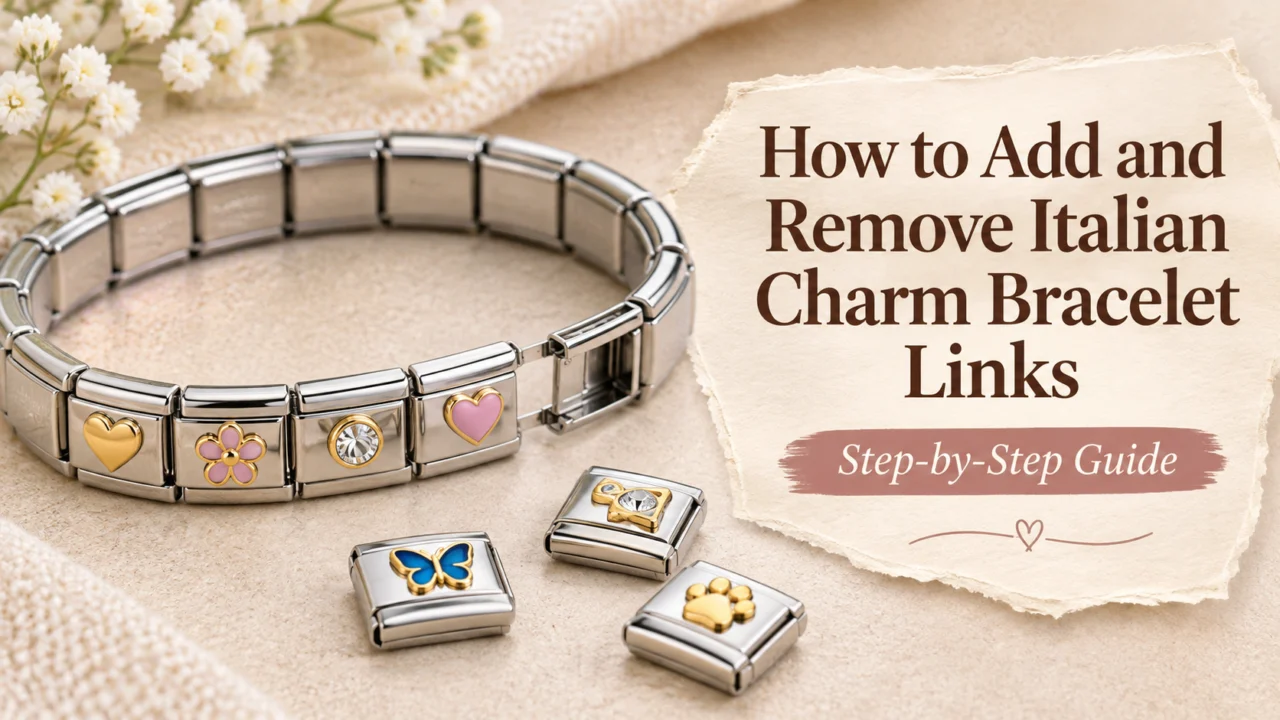
Italian charm bracelets are designed to be personalized, but figuring out how to add Italian charm bracelet links can be surprisingly tricky the first time. Unlike traditional charm bracelets with dangling charms, Italian charm bracelets use individual metal links connected by small, spring-loaded mechanisms.
The good news is that most compatible links can be added, removed, or rearranged at home without special equipment. The key is knowing how the connecting hooks work and applying pressure in the right direction.
This step-by-step guide explains how to safely change Italian charm bracelet links, which tools can help, and how to avoid bending or damaging your favorite charms.
How Do Italian Charm Bracelet Links Work?
Italian charm bracelets are made from a series of small, rectangular metal links that connect to form a flexible band. Each link typically features a decorative front and a hidden spring-loaded connecting mechanism underneath.
Instead of using a traditional clasp, these bracelets stretch slightly as the links move against one another. The concealed hooks keep the links connected while allowing the bracelet to expand enough to slip over your hand.
The basic mechanism has three important parts:
- Decorative front: The visible surface featuring a symbol, letter, gemstone, pattern, or other design.
- Spring mechanism: The internal component that allows the link to extend and return to its resting position.
- Connecting hook: The small metal attachment that secures one link to the next.
Understanding these components makes adding and removing links much easier.
Not all Italian charm bracelets use identical construction. Nomination Composable bracelets are a well-known example of this expandable system, but other manufacturers may use slightly different designs.
Always check that your replacement links are compatible with your existing bracelet before attempting installation.
What You’ll Need Before Changing Your Bracelet Links
You don’t need an elaborate jewelry-making kit to customize an Italian charm bracelet.
For most standard spring-loaded designs, the following supplies are enough:
- A clean, flat workspace
- A soft microfiber cloth or jewelry mat
- Your bracelet and compatible replacement links
- Clean, dry hands
- An optional Italian charm bracelet link tool
A soft surface helps protect decorative finishes and prevents loose links from sliding away.
Good lighting is also important because the connecting hooks are small and can be difficult to see.
Do You Need an Italian Charm Bracelet Tool?
Not necessarily.
Many Italian charm bracelets are designed so their links can be connected by hand. However, a dedicated link-opening tool can make the process easier, especially for beginners or anyone who has difficulty gripping small metal components.
A compatible charm tool helps hold the spring-loaded section open while you connect or disconnect the hooks.
Avoid substituting sharp household tools such as knives, sewing needles, or screwdrivers. These can scratch the metal, bend connecting components, or cause injuries if they slip.
How to Add Italian Charm Bracelet Links Step by Step
Adding a new Italian charm link involves separating two existing links and attaching the replacement piece using their concealed hooks.
These instructions apply to the common spring-loaded Italian charm bracelet design.
Step 1: Place Your Bracelet on a Soft Surface
Lay the bracelet flat on a microfiber cloth with the decorative side facing upward.
Choose where you want to insert the new link. If you’re building a themed bracelet, consider how the new design will look beside your existing charms.
For a new bracelet, you can start by connecting two compatible links and gradually building the band.
Step 2: Expand the Existing Links
Hold the two links where you want to make the change.
Use your thumb and forefinger to gently extend the spring-loaded mechanism until the small connecting hook becomes accessible.
The movement should be controlled and require only moderate finger pressure.
Don’t twist the links sideways or pull the bracelet apart forcefully. The goal is to expose the hook, not stretch or deform the metal components.
Step 3: Disconnect the Links
While holding the spring mechanism open, carefully slide the connecting hook out of its attachment point.
This separates the bracelet into two sections.
Pay attention to how the hooks and openings align. Understanding their original position will help when you reconnect the bracelet.
If the connection doesn’t release easily, relax your grip and try again with better positioning rather than increasing the force.
Step 4: Attach Your New Charm Link
Pick up your new Italian charm link and orient it so its decorative front faces the same direction as the other charms.
Gently expand the appropriate spring-loaded section to expose its connecting mechanism.
Align the new link’s hook with the opening on the adjacent bracelet link. Guide the hook into position, making sure it is fully engaged before releasing the spring.
Allow the mechanism to return gradually to its resting position.
The new link should sit neatly beside the original link without an obvious gap.
Step 5: Reconnect the Bracelet
Now connect the other side of the new charm to the remaining bracelet section.
Repeat the same controlled process:
- Extend the spring mechanism.
- Expose the connecting hook.
- Align the hook with the neighboring link.
- Guide the hook into the attachment point.
- Release the spring gently.
Check that both connections are properly secured.
Step 6: Check the Bracelet Before Wearing It
Hold the bracelet above your soft workspace and gently move it through its normal range of flexibility.
All links should remain connected, and the newly added charm should align with the others.
Look for visible gaps, crooked links, or a hook that has not seated properly.
If everything is secure, try the bracelet on to check the fit.
Important: Adding a link to an existing bracelet increases its overall length. If you’re replacing a plain link with a decorative one, remove the original link first to maintain approximately the same size.
How to Remove Italian Charm Bracelet Links Safely
Removing links is useful when a bracelet feels too loose, when you want to replace a design, or when you’re rearranging your charm collection.
The process is essentially the reverse of adding a link.
Step 1: Identify the Link You Want to Remove
Lay the bracelet flat and locate the charm you want to take out.
If you’re shortening the bracelet, decide which plain or decorative link can be removed without disrupting your preferred design.
Step 2: Open the First Connection
Hold the link beside the charm you’re removing.
Carefully expand the spring-loaded section until the connecting hook is visible.
Disengage the hook from its neighboring link, using the same gentle sliding motion used during installation.
Step 3: Release the Second Connection
Repeat the process on the opposite side of the charm.
Once both connections are released, the selected link should come free.
Avoid pulling the charm straight out while either hook is still engaged. That can damage the connection or distort the link.
Step 4: Reconnect the Remaining Links
Bring the two loose bracelet sections together.
Expand the appropriate spring mechanism, position the hook inside the neighboring link, and allow the mechanism to close.
Inspect the connection before putting the bracelet back on.
Keep removed charms in a small jewelry pouch or compartmentalized organizer so they’re protected until you want to use them again.
How to Change Italian Charm Links With a Charm Tool
A dedicated Italian charm bracelet tool is especially helpful when the springs are difficult to manipulate with your fingers.
The exact method depends on the tool and bracelet manufacturer, but the general process is straightforward.
- Position the tool against the spring-loaded section according to its instructions.
- Gently use the tool to extend and hold the mechanism open.
- Disconnect the exposed hook from the neighboring link.
- Remove or insert the desired charm.
- Reconnect the hook and carefully release the tool.
Use only a tool designed for your bracelet’s mechanism. A tool intended for one link system may not fit another correctly.
Never force a tool into a narrow opening or use it as a lever against a decorative surface.
Common Mistakes That Can Damage Italian Charm Bracelets
Italian charm bracelets are designed for customization, but the small connecting mechanisms still require careful handling.
| Common mistake | Why it causes problems | Better approach |
|---|---|---|
| Pulling links apart forcefully | May bend hooks or strain springs | Extend the mechanism gradually |
| Using sharp metal tools | Can scratch finishes or damage components | Use fingers or a compatible charm tool |
| Mixing incompatible link sizes | Prevents proper alignment and attachment | Check the manufacturer’s link specifications |
| Twisting links sideways | Can distort the spring assembly | Follow the link’s intended expansion direction |
| Wearing a loose connection | Increases the risk of losing a charm | Inspect both attachment points before wearing |
One of the most important habits is checking every connection after making adjustments.
Even if a link appears attached from the front, its hidden hook may not be fully seated.
What to Do When an Italian Charm Link Gets Stuck
Sometimes a link refuses to open, particularly if the bracelet is older or the mechanism has accumulated dirt.
If you’re having trouble, try these simple troubleshooting steps.
Check the Direction of Movement
Make sure you’re extending the spring-loaded component rather than bending the decorative face.
The mechanism should move along its intended path without twisting.
Improve Your Grip
Dry your fingers and place the bracelet on a non-slip surface.
A clean microfiber cloth can help you stabilize the bracelet without scratching it.
Inspect for Dirt or Debris
Look closely for visible residue around the connection.
If your bracelet’s materials permit it, gently clean the accessible area with a soft, dry brush or cloth. Don’t soak the bracelet or apply cleaning chemicals without confirming they are safe for every material and decorative element.
Stop If the Mechanism Appears Damaged
If a hook is bent, a spring seems jammed, or the link won’t return to its normal position, stop attempting to open it.
Repeated force can turn a minor problem into permanent damage.
A professional jeweler or an authorized retailer familiar with the bracelet system may be able to inspect the connection.
How Many Links Should an Italian Charm Bracelet Have?
The correct number depends on your wrist size, the dimensions of your links, and how snugly you prefer to wear your bracelet.
For example, Nomination offers standard Composable bracelet configurations with the following link counts:
| Bracelet size | Bracelet length | Number of links |
|---|---|---|
| Small | Approximately 5.9 inches | 17 |
| Medium | Approximately 6.7 inches | 19 |
| Large | Approximately 7.5 inches | 21 |
| Extra Large | Approximately 8.3 inches | 23 |
These measurements refer to specific Nomination bracelet configurations. Other manufacturers may use different dimensions.
To check your fit, measure your wrist with a flexible measuring tape, then compare the result with the manufacturer’s sizing guide.
The bracelet should feel comfortable without digging into your skin or sliding too easily over your hand.
Remember that replacing one existing link with a decorative link generally preserves the bracelet’s length. Adding an extra link makes it longer, while removing a link makes it shorter.
Are All Italian Charm Bracelet Links Interchangeable?
No. This is an important consideration when buying replacement charms.
Italian charm links may look similar but differ in height, connection shape, and internal mechanism.
For example, Nomination has offered Classic links measuring approximately 8 mm in height and Big links measuring approximately 12 mm. These different formats are not interchangeable.
Even links advertised as the same general size may not fit if they come from different bracelet systems.
Before ordering new charms, check:
- The bracelet brand and collection
- Link height and other relevant dimensions
- Hook and spring compatibility
- Any manufacturer-specific requirements
Matching appearance alone does not guarantee a secure connection.
For an especially valuable, sentimental, or discontinued bracelet, choosing verified compatible links is safer than experimenting with uncertain replacements.
How to Keep Your Italian Charm Bracelet in Good Condition
Proper maintenance helps preserve both the decorative appearance and the functionality of the connecting links.
Clean gently. Wipe your bracelet with a soft, dry cloth after wearing it to remove fingerprints and skin oils.
Avoid unnecessary moisture. Some stainless steel links tolerate occasional moisture well, but decorative finishes, adhesives, gemstones, and other embellishments may require more careful treatment.
Store it separately. Keep your bracelet in a soft jewelry pouch or lined compartment to minimize scratching.
Inspect the hooks. Periodically check that the links remain securely attached and the springs return to their normal positions.
Don’t overstretch the bracelet. Expand the links only as much as necessary for comfortable wear and normal customization.
If your bracelet includes gold-plated surfaces, enamel, pearls, or delicate stone settings, follow the care instructions for those materials rather than relying on a single cleaning method.
Frequently Asked Questions
Can you add Italian charm bracelet links without a tool?
Yes. Many spring-loaded Italian charm bracelet links can be installed using your fingers. A compatible charm tool can make the process easier, especially if the links are difficult to grip.
How do you open an Italian charm bracelet?
Gently extend the spring-loaded links until the concealed connecting hook is accessible. You can then disengage the hook to separate the bracelet at that point. Follow the instructions for your specific bracelet design.
Can you remove one link to make an Italian charm bracelet smaller?
Yes. On compatible modular bracelets, removing one link shortens the band. After taking out the link, reconnect the remaining sections and check that the bracelet fits comfortably.
Why won’t my Italian charm links connect?
Possible causes include incompatible sizes, misaligned hooks, an incompletely extended mechanism, or damage to the connecting components. Check compatibility and alignment before attempting again.
Will changing Italian charm links damage my bracelet?
Normal link changes should not damage a bracelet designed for customization when performed correctly. However, excessive pulling, twisting, incompatible parts, or improper tools can damage the hooks, springs, and decorative finishes.
Final Tips for Adding and Removing Italian Charm Links
Learning how to add Italian charm bracelet links becomes easier once you understand the concealed spring and hook mechanism. Most of the work involves gently extending the links, aligning their connectors, and allowing the spring to close securely.
The safest approach is to work over a soft surface, use compatible replacement charms, and never force a connection that doesn’t move naturally.
With a little patience and regular inspection, you can rearrange meaningful charms, adjust your bracelet’s fit, and update its appearance without unnecessarily risking damage to the jewelry.